
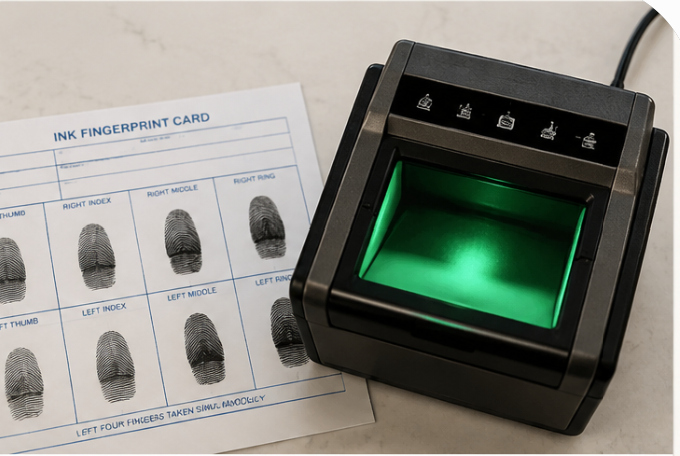
A licensing packet, employment application, professional board, court-related request, or other agency instruction may simply say that fingerprints are required. The next question is whether the request calls for Live Scan or a physical fingerprint card.
The two methods are not interchangeable. The organization requesting the fingerprints determines which method it will accept. Choosing the wrong one can delay an application or require the fingerprinting to be completed again.
Ink fingerprinting vs. Live Scan: the key difference
Live Scan captures fingerprints electronically and transmits them through an authorized system. In California, Live Scan is commonly used for fingerprint-based background checks requested by authorized agencies for employment, licensing, certification, volunteer positions, and similar purposes.
Ink & Roll fingerprinting creates physical fingerprint impressions on a paper card, commonly an FD-258 or another card specified by the requesting organization. The completed card is then submitted according to that organization’s instructions.
Neither service determines whether an applicant passes a background check, receives a license, or qualifies for employment. The fingerprint provider captures the fingerprints and completes the applicable fingerprinting service; the requesting and reviewing agencies handle the background-check or application process.
When Live Scan is usually required
California Live Scan requests generally begin with a Request for Live Scan Service form supplied by the requesting agency. The form contains agency and routing information needed for the electronic submission.
Applicants should use the current form supplied for the specific request rather than assuming a form or receipt from a previous fingerprinting transaction can be reused. Incorrect agency information can cause delays or require another fingerprinting transaction.
Live Scan transmits fingerprints electronically, but electronic submission does not guarantee a particular processing time or outcome. After fingerprinting, the applicant should retain the transaction information or receipt provided by the Live Scan operator. Background-check results are handled by the authorized agencies involved in the request.
Eagle Eye Mobile Notary does not currently provide Live Scan service. If your instructions specifically require Live Scan, schedule with an authorized Live Scan provider.
When Ink & Roll fingerprinting is the right choice
Ink & Roll fingerprinting is appropriate when the requesting organization requires physical fingerprint cards. Card-based fingerprinting is often used for out-of-state requests, federal or professional-board applications, and other recipients that specifically instruct applicants to submit a hard card.
Some organizations provide their own fingerprint card; others direct applicants to use a standard card such as the FD-258. Follow the recipient’s instructions for the card type, number of cards, required fields, signatures or stamps, submission method, fees, and deadline.
Physical cards involve additional handling after the appointment because they may need to be mailed, delivered, or included with an application packet. Confirming the recipient’s requirements before the appointment helps reduce avoidable delays.
Fingerprint quality can be affected by factors such as dry or worn skin, cuts, manual work, age, or movement during capture. A certified fingerprint roller works to obtain clear impressions, but the receiving or reviewing agency determines whether a submitted card is accepted.
A practical comparison before you schedule
| Question | Live Scan | Ink & Roll Fingerprinting |
|---|---|---|
| How are fingerprints captured? | Electronically using a scanner | On a physical fingerprint card |
| How are they submitted? | Electronically through the authorized system | The physical card is submitted according to the recipient’s instructions |
| What should you bring? | The current requesting-agency Live Scan form and valid photo identification | The required card or agency instructions and identification requested for the appointment |
| Who determines which method is required? | The requesting organization | The requesting organization |
| Who provides or evaluates the result? | The authorized reviewing/requesting agency | The receiving or authorized reviewing agency |
How to confirm what you need
Start with the instructions from the organization requesting your fingerprints. If the instructions are unclear, ask whether the request requires electronic Live Scan or physical fingerprint cards, whether a particular form or card must be used, how many cards are required, and who is responsible for submitting the completed fingerprints.
Do not choose a method simply because it appears more convenient. Live Scan is not automatically acceptable for a card-based request, and a physical fingerprint card is not automatically a substitute for a California Live Scan requirement.
What to bring to an Ink & Roll fingerprinting appointment
Bring the fingerprint card supplied by the requesting organization, if one was provided, along with the organization’s instructions. If the organization specifies a standard card such as an FD-258, confirm that requirement before the appointment. Bring appropriate government-issued photo identification and make sure the identifying information used for the appointment is consistent with the application instructions.
Avoid completing fields that the requesting organization says must be completed by the fingerprint roller or agency. If the directions are unclear, bring them to the appointment rather than guessing.
Arrive with clean hands and avoid excessive lotion immediately before fingerprinting. If cuts, bandages, worn ridges, or another condition may affect your fingerprints, mention it at the appointment so the impressions can be handled with appropriate care.
Fingerprinting is separate from notarization
Fingerprinting and notarization are separate services with different purposes. Fingerprinting captures an applicant’s fingerprint impressions for the use specified by a requesting organization. A California notarial act involves a commissioned Notary Public performing the requested lawful notarial act and completing the required notarial record.
California notaries are also required to obtain a journal thumbprint for certain notarizations involving documents affecting real property and powers of attorney. That journal thumbprint is part of the notary’s statutory recordkeeping requirement; it is not Live Scan and it is not an Ink & Roll fingerprint card.
Ink & Roll Fingerprinting with Eagle Eye Mobile Notary
Eagle Eye Mobile Notary provides Ink & Roll Fingerprinting by appointment for clients in Woodland, Davis, West Sacramento, Natomas, and surrounding communities. Dina Mahshi-McWashington is certified through the California Department of Justice Fingerprint Rolling Certification Program.
Eagle Eye Mobile Notary does not currently offer Live Scan. Clients should confirm with the organization requesting the fingerprints that physical fingerprint cards are the required method before scheduling.
The simplest rule is to follow the requesting organization’s instructions. Bring the exact paperwork or card it requires, confirm any special completion or submission requirements in advance, and ask the requesting organization for clarification when its instructions are unclear.