
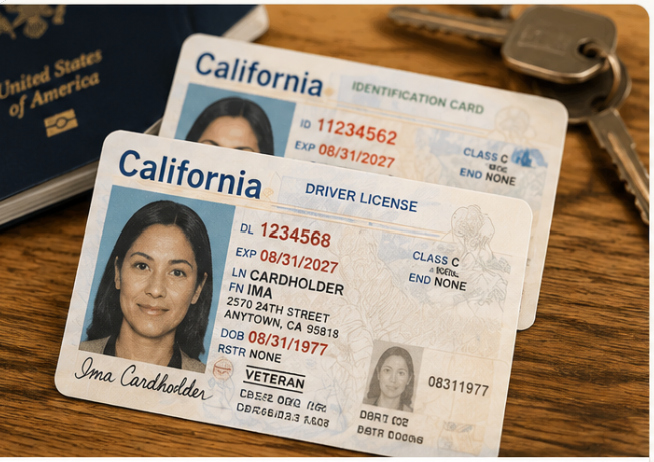
One of the easiest ways for a notary appointment to be delayed is to arrive without identification that meets California’s requirements. A familiar-looking card, a photograph of an ID, or even an identification document accepted for another purpose is not automatically satisfactory evidence for a California notarization.
For acknowledgments and jurats, California law requires the Notary Public to establish the signer’s identity through satisfactory evidence. The rules come from California Civil Code section 1185 and are summarized in the California Secretary of State’s current Notary Public Handbook.
The short answer: bring your physical identification
For most appointments, the simplest option is to have the physical identification document you plan to use available when the notary arrives. California requires the signer to personally appear before the notary, and the Secretary of State instructs notaries to require the identifying document to be presented in person.
Do not plan to use a photograph, photocopy, scan, or screenshot of your identification. California’s mobile driver’s license is also not a replacement for the physical card; the California DMV currently instructs users to continue carrying their physical driver’s license or identification card.
Common identification documents California notaries may accept
Under California Civil Code section 1185, a notary may reasonably rely on certain identification documents when the statutory requirements are satisfied. The most common options include:
- A California DMV driver’s license or identification card.
- A U.S. passport. The California Secretary of State has confirmed that this includes a U.S. Passport Card as well as a passport book.
- A driver’s license issued by another U.S. state.
- An identification card issued by another U.S. state.
- A driver’s license issued by an authorized Canadian or Mexican public agency.
- A qualifying foreign passport from the signer’s country of citizenship.
- A qualifying consular identification document issued by a consulate from the signer’s country of citizenship.
- A qualifying U.S. military identification card.
- A qualifying employee identification card issued by the State of California or a California city, county, or city and county agency or office.
- A qualifying identification card issued by a federally recognized tribal government.
California law also contains specific identification provisions for people in custody in California state prisons or local detention facilities.
The five-year rule is commonly misunderstood
An ID does not always have to be unexpired to qualify for a California notarial act. For the identification documents covered by Civil Code section 1185, the statute generally permits reasonable reliance when the document is current or was issued within the preceding five years, subject to the requirements that apply to that category of identification.
That means the date the ID was issued matters—not simply the expiration date printed on the card.
For example, an expired California driver’s license may potentially satisfy the statutory timing requirement if it was issued within the preceding five years. By contrast, an ID that expired recently but was issued more than five years ago may fail the timing requirement.
Because the details matter, clients with expired identification should send only the ID type, issuing agency, issue date, and expiration date when asking whether it appears to meet the timing requirement. Do not send a photograph of your ID or its identification number through the website.
Some IDs have additional requirements
For several forms of identification—including out-of-state IDs, qualifying foreign passports and consular IDs, military IDs, qualifying California government employee IDs, and federally recognized tribal IDs—the document must also contain the information required by Civil Code section 1185, including a photograph, description of the person, the person’s signature, and a serial or other identifying number.
This is why a card that is perfectly valid for another purpose may not qualify for a California notarization. The California Secretary of State specifically cautions that current military identification cards may not contain all of the information required by the statute.
What about a REAL ID?
A California driver’s license or identification card does not need the federal REAL ID designation merely to qualify as identification for a California notarial act. The relevant question is whether the identification satisfies California’s notary identification requirements.
Can a notary accept me because they already know me?
Not by personal knowledge alone. California requires satisfactory evidence of identity for an acknowledgment or jurat even when the notary personally knows the signer. The 2026 California Notary Public Handbook specifically addresses this point.
What if I do not have an acceptable ID?
California law permits identity to be established through credible witnesses in limited circumstances. This is not simply a matter of bringing a friend or relative who recognizes you.
A credible witness must satisfy statutory requirements, including personally knowing the signer, swearing or affirming that the signer is the person named in the document, and reasonably believing it would be very difficult or impossible for the signer to obtain another authorized form of identification. The signer also must not possess an identification document authorized by law. A credible witness cannot have a financial interest in, or be named in, the document.
If the notary personally knows one qualifying credible witness, California law provides a one-witness procedure. If the notary does not personally know the witnesses, two qualifying credible witnesses may be used. The notary must establish the credible witness or witnesses’ identities using qualifying identification and complete the required journal entries.
Because credible-witness identification has specific legal requirements, contact Eagle Eye Mobile Notary before scheduling if the signer does not possess acceptable identification. Do not assume a credible witness can be substituted simply for convenience.
Why Eagle Eye Mobile Notary takes ID verification seriously
Identity verification is one of the central protections of the notarial process. Dina Mahshi-McWashington takes that responsibility seriously and carefully compares the identification presented with the signer appearing before her, reviews the information required by California law, and records the required identifying information in her notarial journal.
As an additional fraud-deterrence step, Dina also uses a Fraud Fighter® ultraviolet ID-verification pen when appropriate to inspect security features that may be present in an identification document. This supplemental screening is not required by California notary law, does not replace the statutory satisfactory-evidence requirements, and cannot guarantee that an identification document is authentic. It is an added verification practice used alongside the required identification review.
The California Secretary of State advises notaries to be cautious when inspecting identification and to confirm that the photograph and description on the identification document match the person appearing before them. Eagle Eye Mobile Notary’s approach is designed around that responsibility—not simply checking a box and moving on.
Before your appointment: a 60-second ID check
Before Eagle Eye Mobile Notary travels to your appointment, confirm these basics:
- You have the physical identification document available—not merely a photo, scan, or screenshot.
- The ID is one of the forms California law permits for the notarial act.
- If the ID is expired, check the issue date rather than assuming the expiration date alone determines whether it can be used.
- The name on the identification reasonably supports the identity of the person signing. If there is a significant name discrepancy, discuss it before the appointment.
- If the signer has no qualifying identification, contact Eagle Eye Mobile Notary before arranging credible witnesses.
A little preparation can prevent a failed appointment
California’s identification rules exist to protect the integrity of the notarial act. A notary is not simply confirming that a person has some form of photo ID; the notary must have satisfactory evidence of the signer’s identity that meets California law.
Eagle Eye Mobile Notary provides mobile notary appointments in Woodland, Davis, West Sacramento, Natomas, and surrounding communities. If you are unsure whether the identification you have can be used, contact Eagle Eye Mobile Notary before the appointment with the type of ID, issuing agency, issue date, and expiration date. Please do not send photographs, ID numbers, or other sensitive identification information through the website.